Silver Prize
Design and Validation of Low Noise Airfoil Inspired by Flight of Owl
Minsin Kim, Chanyoung Ahn, Youjin Im, YoonSeoung Park, Kyung Chun Kim
KSME Nov 2019
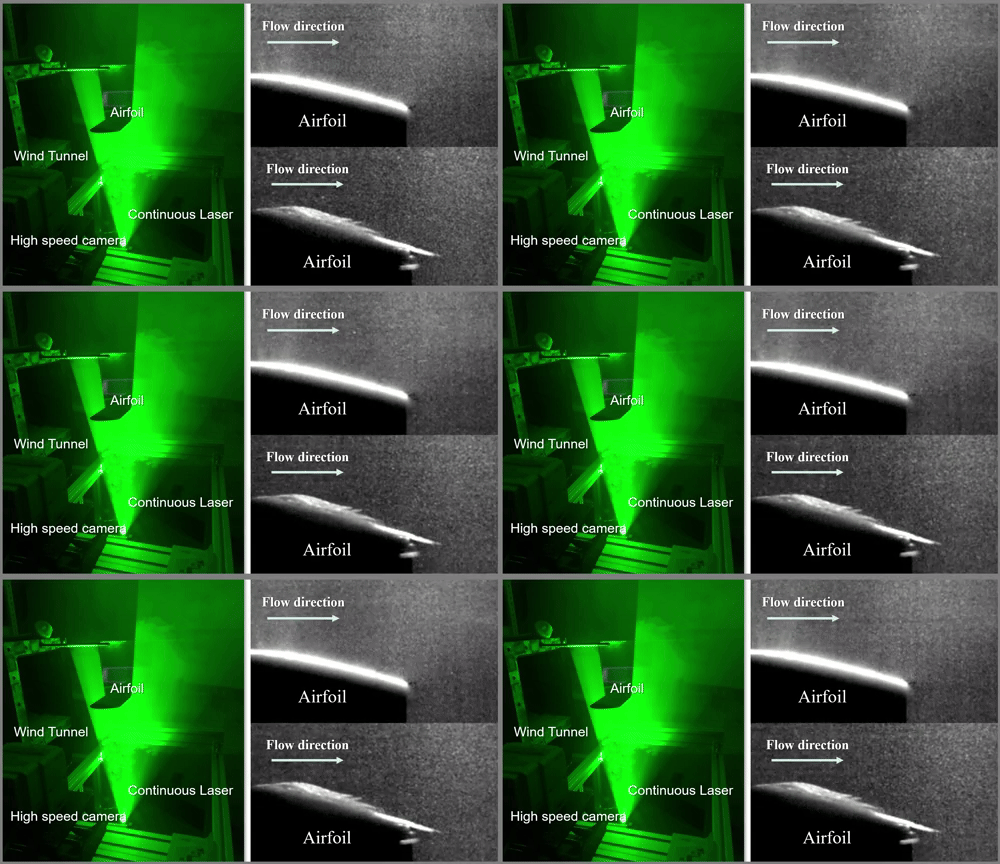
Compared to other birds, owls fly achieving remarkably low noise even that human cannot hear. It is well known that the silent flight owes to both huge size of owl’s wing and microscopic morphologies of feathers, which make up wings, composed of leading edge serration, trailing edge fringes, and velvet surface. To validate the noise reduction effect by applying owl’s characteristics to an airfoil model NACA0018. Three models: (1) without and (2) with leading edge serrations and trailing edge fringes and (3) with serrations and feathers were prepared for comparison. Using particle image velocimetry (PIV) and a blow-down low speed wind-tunnel, flow characteristics of boundary layer and wake are measured with the three different models at two angle of attacks. It is found that the hairy wing with serration prevents flow separation followed by noise reduction.
 ICRA 2025 Arts in Robotics 2025